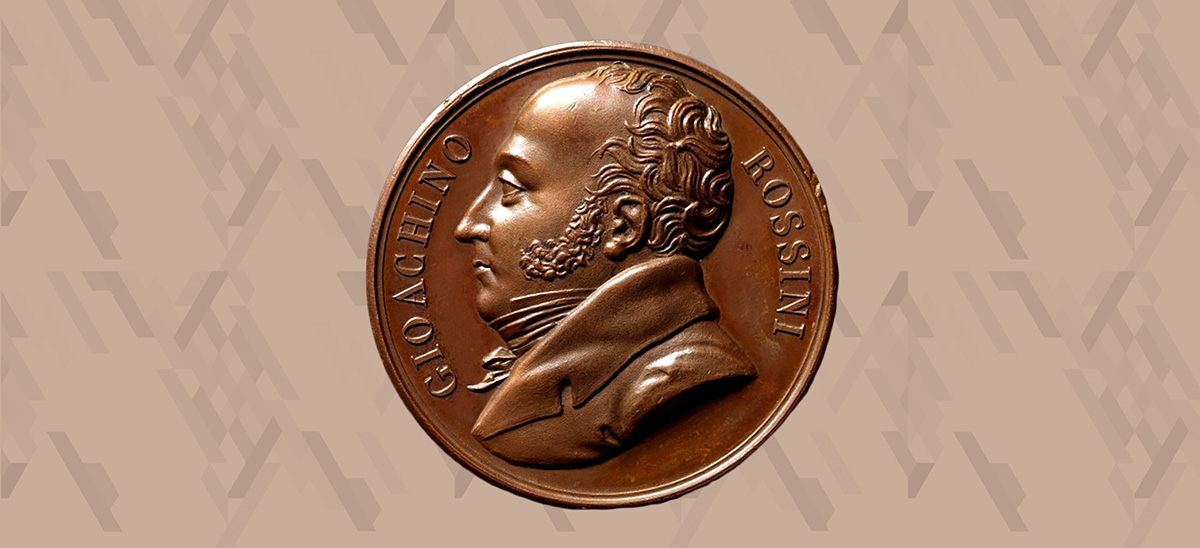
The Fondazione Rossini tells the story
A musical spectre is haunting early nineteenth-century Europe. It is Rossini’s music – or, to put it more accurately, its avatar, its disembodied emanation – which has emerged from the theatres to be reinterpreted, re-heard and reworked. Those who conjure up this ghostly entity are Rossini’s colleagues, both humble and more famous (Liszt, to name but one); their magical instruments come in all shapes and forms: military bands, keyboards, flutes, violins, various ensembles; at times the spectre ventures into the streets and squares, mingling with folk music; but more often than not, the preferred venues for enjoying Rossini’s music are the comfortable private homes of the bourgeoisie and the aristocracy: from the boxes, one ends up listening to it from chairs, to paraphrase the title of a book by Carlida Steffan and Luca Zoppelli (Carocci, 2023).
Nowadays, when we think of Rossini’s works, we think above all of the theatre (particularly the Rossini Opera Festival), but we should never forget that, in the absence of recordings, websites and apps where we can access virtually any music we want almost anywhere, there were ‘period YouTube’ equivalents that made Rossini accessible beyond the theatre. One such medium was undoubtedly the guitar: an ancient instrument which, particularly between the 18th and 19th centuries, achieved an Apollonian balance between ease of handling and versatility in the repertoire it could perform. With its recognisable, delicate sound, tinged with a touch of exoticness, the guitar is perfect for more intimate spaces – the salons of the ‘capital of the world’ (to borrow a phrase from Walter Benjamin), namely Paris. This was well understood by some of the composers who flooded the market. The first to spring to mind are Fernando Sor and Mauro Giuliani, composer of the Rossiniane; but Italian virtuosos and teachers, both of whom lived in Paris – Ferdinando Carulli (1770–1841) and Matteo Carcassi (1796–1853) – played no small part in the dissemination of this music.
In the very year that the Rossini Opera Festival returns to Paris to mark the bicentenary of Le Siège de Corinthe, attending a concert dedicated to their guitar transcriptions is an essential complement to understanding Gioachino Rossini’s central role in the France of that era, which was captivated by the composer from Pesaro. Added to this is the extremely rare performance of this music (symphonies, dance arias) accompanied by a period piano – incorrectly termed a fortepiano – which discreetly allows the guitar the necessary sonic space. And finally, we too might say of Rossini, echoing Metastasio: ‘we love to hear him repeat himself’. The physical pleasure conveyed by Rossini’s music—which is music before it is theatre, yet remains theatre even when it is merely music—remains intact, whatever the medium through which it reaches us.
Daniele Carnini
Published in : 24 June 2026
- Share :


