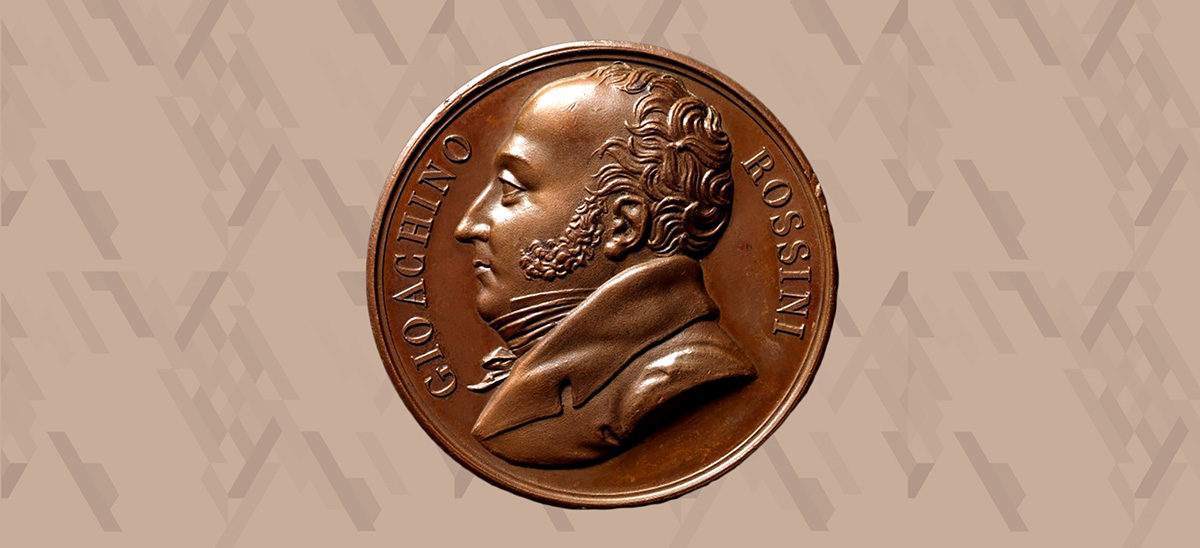
The Fondazione Rossini tells the story
Venice, 9 May 1812, Teatro San Moisè; the first performance of La scala di seta has reached Scene XII. On stage, Giulia, as she does every night, is preparing to receive her beloved Dorvil: thanks to a ladder lowered from the balcony, the young man is able to secretly reach the girl’s room. However, the events of the day that is drawing to a close have left their mark on Giulia’s heart; the unexpected arrival of her suitor Blansac and the unforeseen developments that followed have deeply troubled her. Perhaps for the first time, Giulia fears that her relationship with Dorvil might be discovered by her guardian Dormont and that Dorvil himself might doubt her sincerity. This is the dramatic situation in which the librettist Giuseppe Foppa – and Rossini with him – places Giulia’s aria ‘Il mio ben sospiro e chiamo’, the emotional and sentimental climax of the entire story, as well as a musically challenging passage demanding great interpretative skill. The co-protagonist is the instrument (as it was called at the time) known as the ‘concertante’ or ‘obbligato’, which expresses the young woman’s doubts beyond the words themselves; it is a very distinctive instrument, with a dark yet penetrating timbre, the ‘elder brother’ of the oboe: the English horn.
This was probably not the first time Rossini had attempted to write a solo part for the English horn. He may well have used it as early as 1811 in the cantata La morte di Didone, which, however, was not performed until 1818 in Venice, the birthplace of La scala di seta. This latter opera was therefore the first public appearance of the Rossini-English horn pairing, destined to bear abundant fruit: Sofia’s aria ‘Ah donate il caro sposo’ in Il signor Bruschino (Venice, 1813), Amenaide’s cavatina ‘No, che il mori non è’ in Tancredi (Venice, 1813), Ladislao’s aria ‘Giusto ciel che i mali miei’ in Sigismondo (Venice, 1814; a passage later reprised in Adina), Ottone’s cavatina ‘Soffri la tua sventura’ in Adelaide di Borgogna (Rome, 1817), Cristina’s Grand Scene ‘Arresta il colpo… halt…’ in Eduardo e Cristina (Venice, 1819), the Gratias from the Messa di Gloria (Naples, 1820), the Zelmira-Emma duet ‘Perché mi guardi e piangi’ in Zelmira (Naples, 1822).
It will not escape notice that most of these pieces were composed for operas that premiered in Venice. From 1780 until well into the second decade of the nineteenth century, the lagoon city in fact hosted, on several occasions, members of the Ferlendis family from Bergamo—outstanding virtuosos of the English horn (and the oboe)—in the orchestras of its theatres. For Giuseppe (1755–1802), the family patriarch, Wolfgang Amadeus Mozart wrote the Concerto for Oboe and Orchestra K. 314/217k; Giuseppe was also highly regarded by Michael Haydn and, in 1795, had the honour of performing in London alongside the double bassist Domenico Dragonetti at a gala concert for Michael’s more illustrious brother, Franz Joseph. As well as performing in theatres, in Venice the Ferlendis also had the opportunity to refine the technical aspects of their instruments in collaboration with Andrea Fornari (1753–1831), a renowned maker of wind instruments. Venice thus became the cradle of the technical and compositional development of the English horn in Italy.
Although no documents currently exist to confirm this, we cannot rule out the possibility that, during his time in Venice, Rossini may have met members of the Ferlendis or Fornari families. In any case, it is clear that he must have found himself immersed in this very particular milieu, the potential of which he knew how to exploit to the full, composing pieces of music that have shaped the history of this instrument, whose inimitable voice, following Rossini’s influence, we find again in Carmen, Tristan und Isolde, and Verdi’s Otello, amongst others.
Andrea Malnati
Published in : 21 May 2026
- Share :


